





Improving Software for Society
News | Blog Post : THE EVOLUTION OF ROBOTS – PART 3
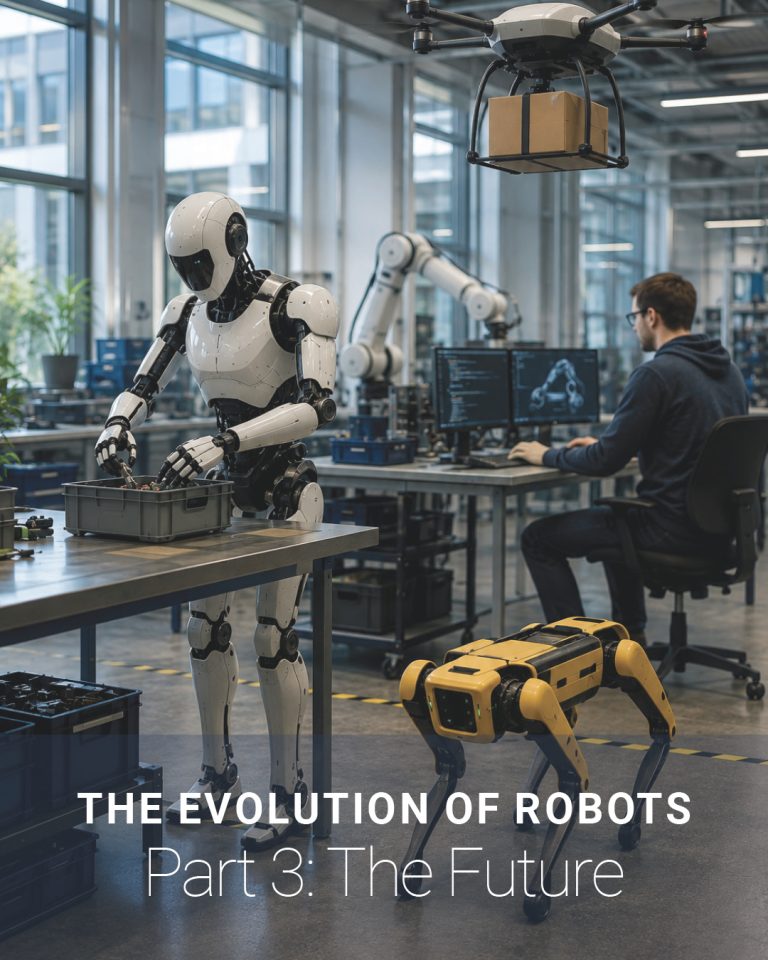
THE EVOLUTION OF ROBOTS – PART 3
18.08.2026
The Evolution of Robots – Part Three: The Future
From Machines to Intelligent Companions: A New Generation of Robotics
Robots are moving rapidly beyond factories and warehouses and into the wider world. Advances in artificial intelligence, sensors, batteries and “physical AI” are allowing robots to understand their surroundings, learn from experience and respond more naturally to people. Humanoid robots are increasingly being developed for manufacturing, logistics, healthcare and service roles, although making them reliable, affordable and safe enough for everyday use remains a major challenge.
The People and Companies Driving the Revolution
Behind the rapid development of robotics are some of the world’s biggest technology companies, ambitious start-ups and high-profile entrepreneurs. Elon Musk’s Tesla is developing Optimus, a general-purpose humanoid robot designed to carry out repetitive, dangerous and physically demanding tasks. Tesla is investing heavily in the technology and is preparing large-scale manufacturing facilities, with the long-term goal of producing robots in huge numbers.
Tesla is not alone. Figure AI, founded by Brett Adcock, has attracted more than $1 billion in committed investment from companies and investors including NVIDIA, Intel, LG, Qualcomm and Brookfield. Figure’s humanoid robots are already being tested in manufacturing and logistics, including at BMW. NVIDIA, led by Jensen Huang, is also investing heavily in the computing systems and AI models that allow robots to see, understand and interact with the physical world.
Other major players include Agility Robotics, whose Digit humanoid is being deployed for logistics and manufacturing, and Chinese companies such as Unitree Robotics, which has rapidly expanded the market for relatively affordable quadruped and humanoid robots. Together, these companies and their investors are helping turn robotics from experimental technology into a potentially huge global industry.
How Future Robots Could Help Us
The next generation of robots could take on many tasks that are difficult, dangerous, repetitive or physically demanding. In factories, they could handle heavy equipment and work alongside human employees. In agriculture, robots could monitor crops and harvest delicate produce. In hospitals and care settings, they could transport supplies, assist with rehabilitation and support people with everyday activities.
At home, robots could become practical assistants, helping with cleaning, cooking, shopping, lifting objects and monitoring the home. Their purpose will not necessarily be to replace people, but to give us more time and independence while supporting workers where there are shortages.
The Rise of Companion Robots
One particularly interesting development is the next generation of companion robots. Unlike traditional machines designed for a single task, these robots will combine conversation, movement, cameras, sensors and AI to interact with people. They could remind users about appointments and medication, provide entertainment, help people stay connected with family, or offer companionship to those living alone. Research into social robots is already exploring their use in home healthcare, while new AI-powered robot pets and companions are appearing as consumer products.
A More Human-Centred Future
The ultimate purpose of future robotics may be to make everyday life safer, easier and more accessible. Robots could help older people remain independent, assist people with disabilities and perform hazardous jobs that humans should not have to undertake.
However, future development will also need to address safety, privacy, cybersecurity, cost and trust. If these challenges can be solved, robots could become one of the most important technologies of the coming decades—not as replacements for humans, but as intelligent tools designed to work with us.
A Career in Robotics
A career in robotics could include designing, building, programming, and maintaining smart machines. If you want to find out about becoming a Robotics/Automation Engineer go to nationalcareers.service.gov.uk/job-profiles/robotics-engineer.
