





Improving Software for Society
News | Blog Post : APPS & WEBSITES NOT WORKING?
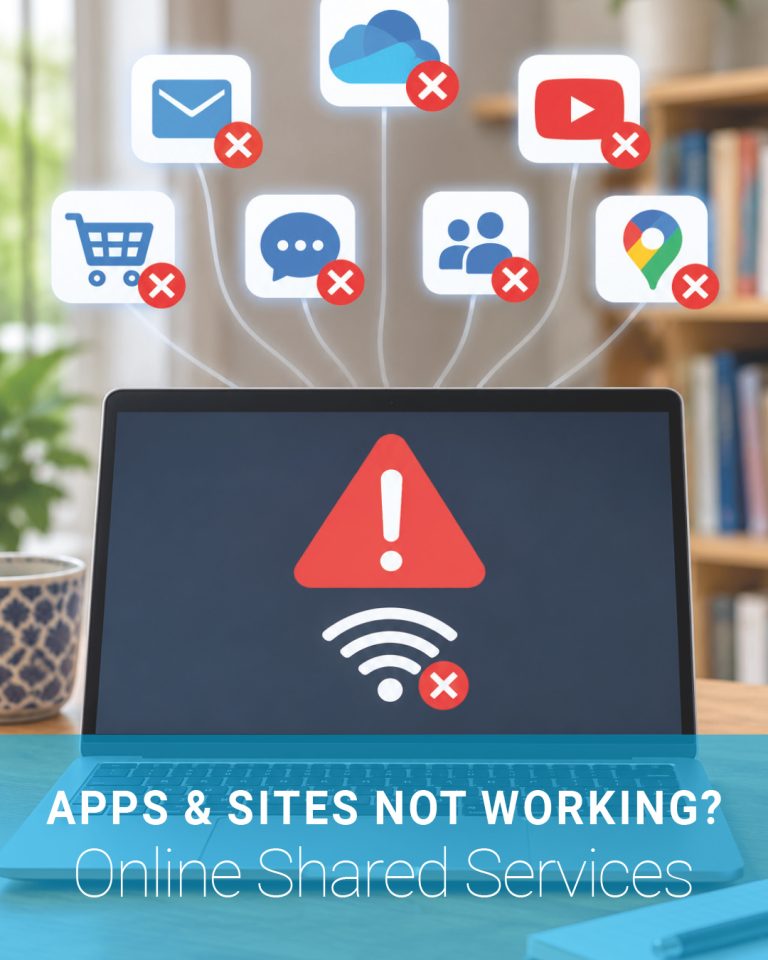
APPS & WEBSITES NOT WORKING?
17.11.2026
Why do several apps and websites stop working at the same time?
The Shared Services Behind Our Online Lives
You try to open a website, but it will not load. Then another app stops working. Perhaps you can browse an online shop but cannot pay, or you are waiting for a sign-in code that never arrives.
It is easy to blame your phone or broadband. Sometimes the problem is much further away, in a service used by several different companies.
Our online lives depend on more shared equipment and services than we usually see. Recent problems at Google and Microsoft show how a fault in one place can spread, affecting people who may have no idea they rely on those companies.
The Companies Behind the Screen
We recognise Microsoft for Windows, Outlook and Teams, Google for Search and Gmail, and Amazon for shopping. All three also provide services that help other organisations run their websites and apps.
Amazon calls this part of its business Amazon Web Services, usually shortened to AWS. Microsoft has Azure, and Google has Google Cloud. They rent out computing power and space to store information, rather like businesses renting premises instead of constructing their own buildings.
The “cloud” is physical equipment in buildings called data centres, connected through networks. The word describes how we access those services over the internet.
Other companies, including Cloudflare, Akamai and Fastly, help websites deliver pages and handle traffic. Some also help protect sites from attacks. You may use their services without ever seeing their names.
What You Do | What May Be Happening Behind The Scenes
Open a website | Services find its address and deliver its pages
Sign in | A separate service checks who you are
View a document or account | A cloud service retrieves the information
Buy something | A payment company processes the transaction
Request a security code | A messaging service sends the text or email
One app can depend on several of these steps working together.
Different Shopfronts Can Share The Same Services
Think of a shopping centre. Each shop has its own name and staff, but several shops may depend on the same electricity supply or entrance.
Online services can work in a similar way. Two websites that look completely separate might use the same company to run their computers, check passwords or process payments.
If that shared service fails, both websites can develop problems at once. Sometimes the whole site becomes unavailable. Sometimes only one part stops working, such as signing in or checking out.
This also explains why a friend may be able to use an app while you cannot. Their account might already be signed in, or their request might reach equipment in a different location.
What Recent Outages Tell Us
On 12-13 November 2026, Microsoft 365 experienced widespread disruption. Independent monitoring company ThousandEyes recorded problems reaching Outlook and other Microsoft 365 services. Its checks showed Outlook had largely recovered by the afternoon of 13 November, UK time, although some locations still had difficulties.
For someone trying to use an affected service, the problem could look like a broken app or a page that would not load. Trying a different device would not necessarily help when both devices needed the same service. This was a separate incident from the earlier Microsoft Azure networking problem described below.
On 20 October 2026, a power problem affected part of Google Cloud’s London operation. A fault in the backup-power controls prevented generators from starting automatically under the conditions at the site. The main disruption lasted just over six hours.
Moving work to other locations helped, but also increased pressure on the remaining equipment. Some services outside the original problem area experienced delays and errors. It was rather like closing one busy road and finding that the diversion routes could not comfortably handle all the extra traffic.
From 30 September into 1 October 2026, Microsoft Azure experienced networking problems across several parts of the world. Microsoft reported that updates caused a surge of requests to a shared management service, which struggled to keep up. Some connections between organisations’ own systems and Microsoft’s cloud were also interrupted.
Earlier incidents show another complication. During an AWS outage in October 2025, an initial problem locating a database service was followed by wider difficulties. Fixing the first fault did not immediately restore everything that depended on it.
And in June 2025, several Cloudflare services were disrupted because part of their underlying storage relied on another cloud provider that experienced an outage. A company helping other websites stay available had its own outside dependency.
These examples do not mean that every service from those companies failed. Outages can affect particular products, locations or groups of customers.
Does An Outage Mean Someone Has Been Hacked
An outage alone does not tell us the cause. Power failures, faulty software, maintenance mistakes and overloaded equipment can all interrupt a service. Cyber attacks can also cause disruption, but an error message is not evidence of an attack.
Being unable to reach information does not, by itself, mean that information has been lost or stolen. Those are separate questions, and the service provider needs to establish what happened.
What You Can Do When Something Stops Working
You cannot repair a distant data centre, but you can avoid unnecessary troubleshooting and keep useful alternatives available.
• Check whether other sites work. If several unrelated sites load normally, the problem may be with the particular service you need.
• Look for an official service update. Use the provider’s app or website, or a bookmark you already trust. Public reports can offer clues before an official update appears, but may not identify the cause accurately.
• Try another connection once. Switching between home broadband and mobile data can help establish whether your connection is involved. Both still depend on the website’s own services.
• Avoid repeatedly submitting a payment or booking. If the result is unclear, check your account, confirmation messages or order history before trying again.
• Keep essential information available offline. Save travel tickets, booking details and important contact numbers securely on your device or on paper where appropriate.
• Use another contact route. A telephone number or an in-person service may help when the usual app is unavailable, although those alternatives can also be affected.
Repeatedly changing passwords or reinstalling apps will not fix a supplier’s outage. Check what is happening before making major changes to your device or account.
What We Should Expect From Businesses
Businesses cannot promise that technology will never fail. They can explain what is affected, provide useful updates and plan how to help customers while systems are unavailable.
For essential services, that means considering people who cannot simply wait for an app to return. Clear telephone contacts, accessible alternatives and sensible arrangements for interrupted transactions can make a considerable difference.
The convenience of online services comes from many systems working together. Understanding those connections helps explain why several things sometimes fail at once – and why keeping a few practical alternatives matters.
Sorces and Further Reading
Prepared 15 November 2026. The examples are selected documented incidents, rather than a complete list of outages or a comparison of provider reliability.
Microsoft Azure – Cloud products
Google Cloud – Products and services
Google Cloud – London incident report for October 2026
Microsoft Azure – Incident history, networking incident of 30 September 2026, reference 7Q30-010
AWS – October 2025 service disruption report
Cloudflare – Service outage of 12 June 2025
Cisco ThousandEyes – Microsoft 365 outage analysis for 12-13 November 2026
