





Improving Software for Society
News | Blog Post : QUANTUM COMPUTING IN 2026
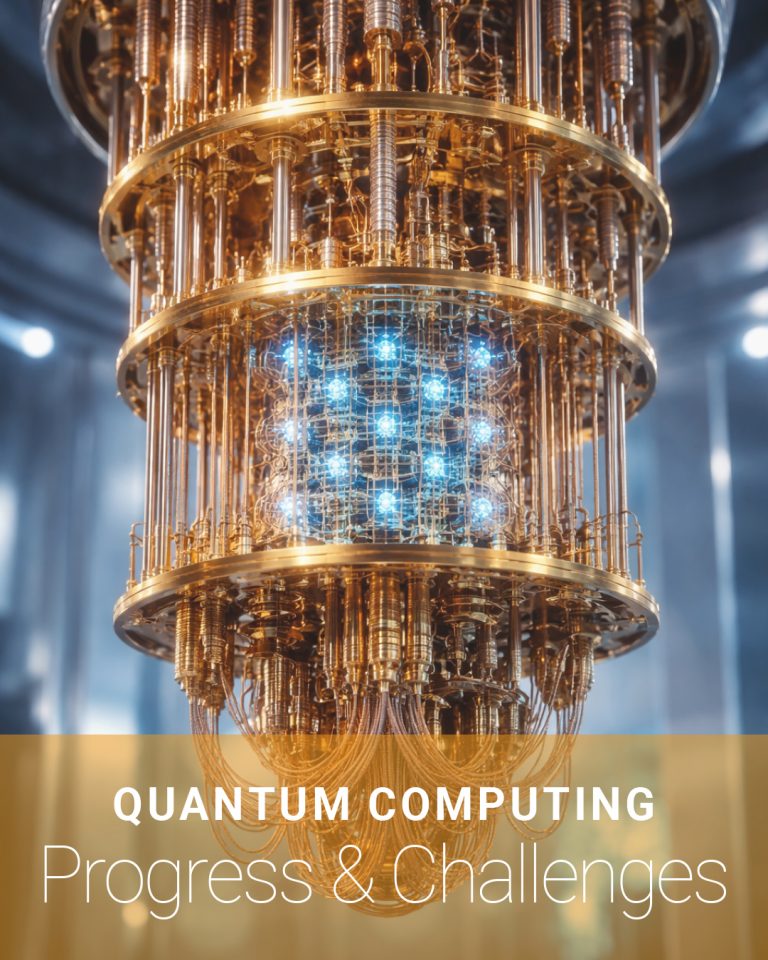
QUANTUM COMPUTING IN 2026
24.02.2026
Quantum Computing in 2026: Progress, Challenges and What’s Next?
Quantum computing has evolved from laboratory theory into a strategic priority for governments and major tech companies. While we’re not yet at large-scale commercial deployment, recent years have brought steady technical progress and clearer roadmaps toward practical systems.
What Makes Quantum Computers Different?
Classical computers use bits (0 or 1). Quantum computers use qubits or quantum bits. Qubits process certain problems in fundamentally new ways, with:
– Faster factoring of large numbers
– Molecular and materials simulation
– Complex optimization
– Select machine learning enhancements
Key Industry Players
IBM has focused on scaling hardware while prioritizing error correction and logical qubits over raw qubit counts — a sign the field is maturing.
Google Quantum AI is concentrating on fault tolerance and reducing logical error rates using surface codes.
IonQ uses trapped-ion technology, known for long coherence times and strong qubit connectivity, and offers systems through cloud platforms.
Microsoft is pursuing topological qubits, an experimental but potentially more stable approach to quantum hardware.
The Core Challenge: Error Correction
The challenge remains stability — qubits are extremely fragile and prone to errors. We are still in the NISQ (Noisy Intermediate-Scale Quantum) era. True breakthrough will require stable ‘logical’ qubits, likely built from thousands (or more) physical qubits each. This is the industry’s central focus.
What Are The Applications?
Next 3–5 years will see experimental chemistry simulations, optimization pilots (energy, logistics, finance) and hybrid quantum–classical research.
Longer term (10+ years with fault tolerance) will see breaking RSA encryption, large-scale materials discovery and major advances in optimization and AI.
Global Investment
The longer term potential is driving investment in post-quantum cryptography today. Quantum computing is now geopolitically strategic. The US, EU, and China are investing heavily in hardware, communication systems, and research infrastructure. It is increasingly viewed alongside AI and semiconductor leadership as a national priority.
What’s Next?
Quantum computing in 2026 sits between promise and practicality. It is not yet transformative but it is steadily advancing. The true turning point will be the first scalable, fault-tolerant quantum computer capable of solving problems beyond classical reach. That milestone, when achieved, will mark the real beginning of the quantum era.
Further Reading
If you want to take a deeper dive into the world of quantum computing:
An Open University free course covering the basics of qubits, algorithms, and how quantum computing differs from classical computing: www.open.edu/openlearn/introduction-quantum-computing.
Explore Quantum Computing from the UK’s National Quantum Computing Centre (NQCC): www.nqcc.ac.uk/what-is-quantum-computing.
