





Improving Software for Society
News | Blog Post : COMPUTING PIONEERS WHO CHANGED THE WORLD
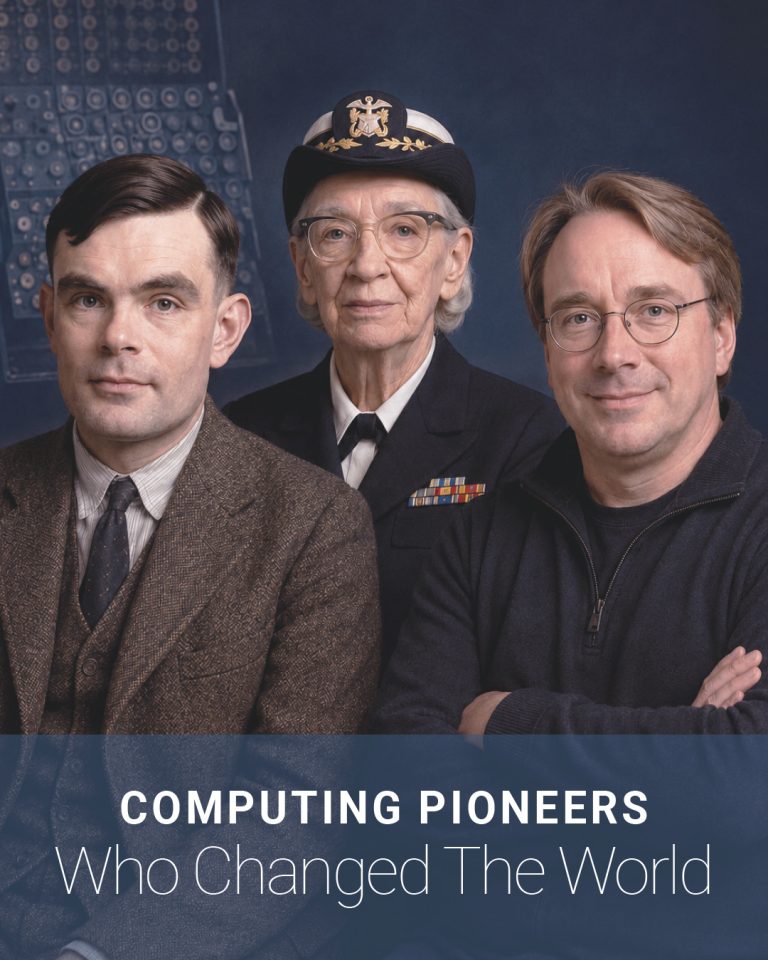
COMPUTING PIONEERS WHO CHANGED THE WORLD
07.07.2026
Computing Pioneers Who Changed The World
Groundbreaking Ideas that Transformed Computing
Modern computers, smartphones, and the internet are all the result of the work of remarkable inventors, mathematicians, engineers, and computer scientists. Over the past two centuries, these pioneers have developed groundbreaking ideas that transformed computing from simple mechanical machines into the powerful digital systems we use every day. Their inventions have influenced communication, science, business, education, and entertainment across the world.
The following computing pioneers made some of the most significant contributions to computer science and technology.
Ada Lovelace (1815–1852) was an English mathematician who worked with Charles Babbage on his proposed Analytical Engine. She is widely recognised as the world’s first computer programmer because she wrote the first published algorithm designed to be carried out by a machine. Lovelace also predicted that computers could one day create music, produce graphics, and process information beyond simple calculations. Find out more about Ada Lovelace – Encyclopaedia Britannica.
Charles Babbage (1791–1871) was an English mathematician, inventor, and engineer. He designed the Difference Engine and later the more advanced Analytical Engine, which included many of the features found in modern computers, such as memory, a processor, and programmable instructions. Although his machines were never completed during his lifetime, his designs inspired future generations of computer engineers. Find out more about Charles Babbage – Encyclopaedia Britannica.
Alan Turing (1912–1954) was a British computer scientist, mathematician, and logician. During the Second World War, he played a crucial role in breaking the German Enigma code, helping the Allies win the war. After the war, he developed ideas about artificial intelligence and created the famous Turing Test to measure whether a machine could demonstrate intelligent behaviour. He is widely regarded as the father of modern computer science. Find out more about Alan Turing – Encyclopaedia Britannica.
John von Neumann (1903–1957) was a Hungarian-American mathematician whose work transformed computer design. He developed the stored-program computer architecture, in which both instructions and data are stored in memory. This design is still used in most computers today and became the standard model for computer systems around the world. Find out more about John von Neumann – Encyclopaedia Britannica.
Claude Shannon (1916–2001)was an American mathematician and electrical engineer known as the father of information theory. He proved that all digital information could be represented using binary numbers (0s and 1s). His research laid the foundations for modern digital communications, data compression, computer networks, mobile phones, and the internet. Find out more about Claude Shannon – Encyclopaedia Britannica.
Edsger W. Dijkstra (1930–2002) was a Dutch computer scientist who made important contributions to algorithms, operating systems, and software engineering. His famous shortest-path algorithm is used in GPS navigation, internet routing, and mapping software. He also promoted structured programming, encouraging programmers to write clearer, more reliable code. Find out more about Edsger W. Dijkstra – Encyclopaedia Britannica.
Dennis M Ritchie (1941–2011) was an American computer scientist who created the C programming language and co-developed the Unix operating system at Bell Labs. C became one of the world’s most influential programming languages, while Unix inspired many modern operating systems, including Linux and macOS. His work continues to influence software development today. Find out more about Dennis Ritchie – Encyclopaedia Britannica.
Grace Hopper (1906–1992) was an American computer scientist and U.S. Navy Rear Admiral. She developed one of the first computer compilers, making programming much easier, and helped create COBOL, one of the first high-level programming languages for business. She also popularised the term “debugging” after removing a moth from a computer relay. Find out more about Grace Hopper – Encyclopaedia Britannica.
Linus Torvalds (1969–present) is a Finnish software engineer best known for creating the Linux operating system kernel in 1991. Linux now powers millions of servers, smartphones, supercomputers, and embedded devices around the world. Torvalds also created Git, one of the most widely used version control systems for software development. Find out more about Linus Torvalds – Encyclopaedia Britannica.
Tim Berners-Lee (1955–present)is a British computer scientist and physicist who invented the World Wide Web in 1989 while working at CERN. He developed the first web browser, web server, HTML, HTTP, and URLs, making it possible for people to access and share information through websites. He continues to promote an open and accessible internet for everyone. Find out more about Tim Berners-Lee – Encyclopaedia Britannica.
Without the vision and achievements of these computing pioneers, modern technology would look very different. Their innovations in programming, computer architecture, operating systems, algorithms, networking, and the World Wide Web continue to shape the devices and software that billions of people use every day. Their work demonstrates how creativity, mathematics, and engineering can change the world.
