





Improving Software for Society
News | Blog Post : COMPUTER LANGUAGES
COMPUTER LANGUAGES
07.04.2026
Computer Languages
How many computer languages are there?
You may have noticed that over the past few years, via a weekly social media post, we’ve been making our way through the many different computer languages, and there are plenty more to choose from so we’ll keep going! There is no official count but it is estimated there are nearly 9,000 computer languages listed in historical databases but only a fraction, around 50 to 700, are currently in use. About 50 languages are considered popular and they make up the bulk of commercial development.
How did it all start?
The history of computer languages dates back to the 1940s, when early computers were programmed using machine code-long strings of binary numbers that were difficult for humans to read and write. To simplify this, assembly languages were introduced in the 1950s, allowing programmers to use symbolic instructions. Shortly after this, high-level languages like FORTRAN and COBOL were developed, making programming more accessible and efficient. These innovations laid the foundation for modern programming languages, enabling the rapid growth of software development and computing technology.
What computer languages are most popular?
The world of programming is powered by a diverse set of languages, each designed for specific tasks and industries. Among the most popular is Python, known for its simplicity and versatility. It is widely used in web development, data science, and artificial intelligence. Find out more about Python at www.python.org.
Another dominant language is JavaScript, essential for creating interactive websites. It runs in all modern browsers and is supported by frameworks like React and Node.js. Explore it here developer.mozilla.org/JavaScript.
Java remains a staple in enterprise environments due to its stability and portability. It powers large-scale systems and Android apps. Visit www.oracle.com/java for details.
Finally, C# is popular within the Microsoft ecosystem, especially for building Windows applications and games using Unity learn.microsoft.com/en-us/dotnet/csharp. For system-level programming, C++ is highly valued for its performance and control over hardware. It is commonly used in game development and real-time systems: https://isocpp.org/.
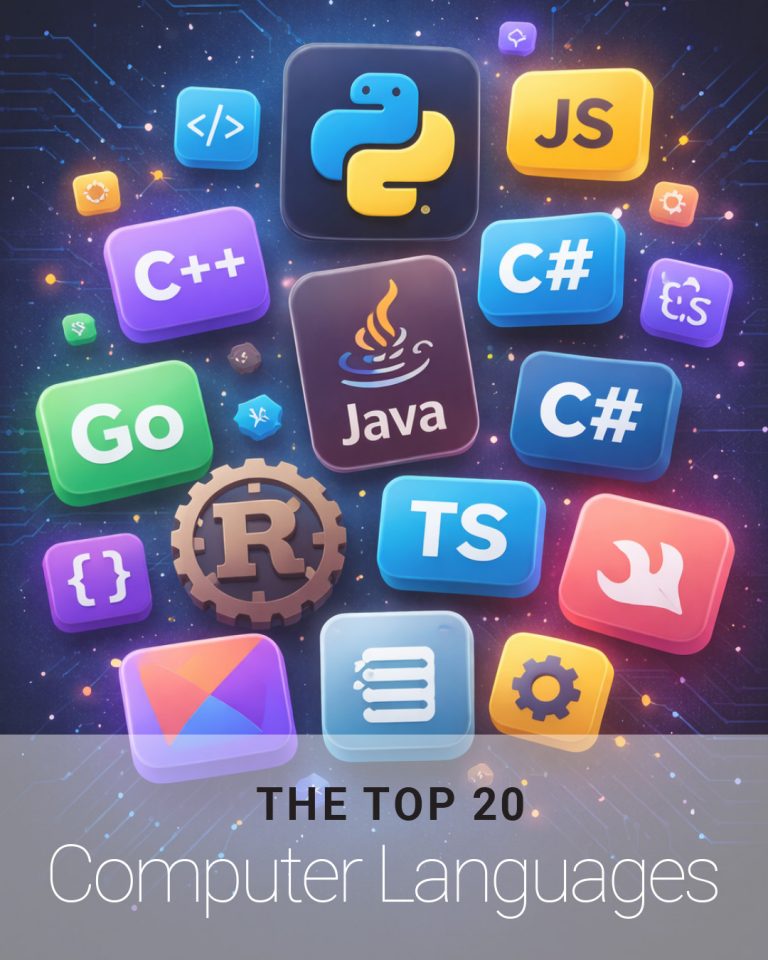
The Top 20
• Python
• JavaScript
• Java
• C#
• C++
• PHP
• Ruby
• Swift
• R
• SQL
• Kotlin
• TypeScript
• Go
• Rust
• Scala
• Dart
• Perl
• MatLab
• VBA
• Shell Scripting
What’s the future looking like?
In the future computer language development will focus on efficiency, readability, and adaptability. Languages will no doubt increasingly integrate AI-assisted coding and cross-platform compatibility and security will be central. There will be more computer language experts but the definition of expertise is evolving from simply writing code to orchestrating AI-driven development and managing complex systems. And good news, while AI coding tools are proliferating, they are driving demand for more developers with specialised skills rather than replacing them.
