





Improving Software for Society
News | Blog Post : IAP WEBINAR: ENTERPRISE AI
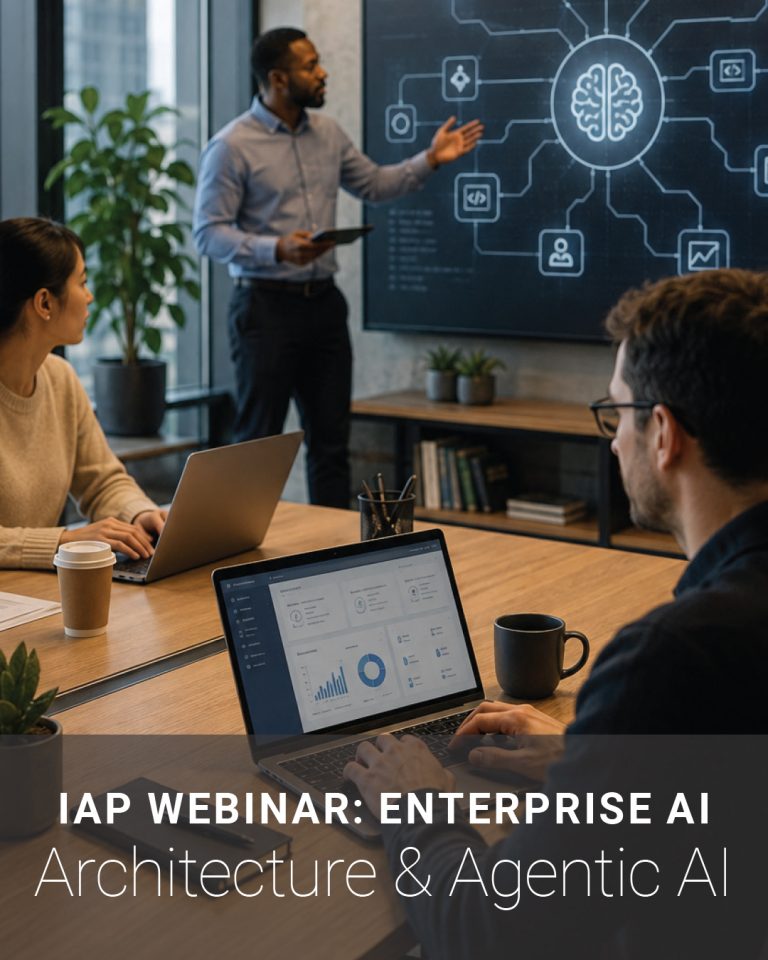
IAP WEBINAR: ENTERPRISE AI
01.09.2026
The Next IAP Webinar
Enterprise AI Architecture and Agentic AI
Our next Webinar will be held on Thursday, 24th September 2026 at 2pm (BST) / 9am EDT.
The topic of this webinar is Enterprise AI Architecture and Agentic AI and there will be a practical focus on how organizations can move beyond standalone LLMs toward secure, scalable, and governed AI agent systems.
How to Attend the Live Webinar
IAP members will be sent a link by email with further information about this webinar and how to join. If you have any queries or require further information prior to this please email admin@iap.org.uk.
An Introduction to Enterprise AI Architecture and Agentic AI
Enterprise AI is moving beyond individual chatbots and isolated machine-learning tools. Organisations are increasingly developing AI architectures that connect models, data, applications and business processes into a secure, scalable environment.
A modern enterprise AI architecture typically combines cloud or on-premise infrastructure, data platforms, AI models, APIs, security controls and governance. The aim is to make AI available across the organisation while ensuring that sensitive information remains protected and systems can be monitored and managed effectively.
The next major development is agentic AI. Unlike conventional AI applications that respond to individual prompts, AI agents can pursue objectives, plan tasks, use tools and take actions with limited human intervention.
For businesses, this could mean agents managing customer enquiries, analysing documents, monitoring cybersecurity alerts, preparing reports or coordinating complex workflows. Multiple specialised agents could also work together, with each responsible for a particular stage of a business process.
However, greater autonomy creates new risks. Agents may have access to corporate data, software systems and financial or operational processes. Strong identity controls, permissions, monitoring and human oversight are therefore essential.
Successful enterprise AI requires more than choosing the most powerful model. Organisations need an architecture that supports security, governance, interoperability and accountability from the beginning.
This includes controlling what agents can access, recording their actions, validating outputs and establishing clear boundaries around autonomous decision-making. As agentic AI becomes increasingly integrated into business operations, enterprise architecture will play a crucial role in determining whether these systems remain useful, reliable and trustworthy.
The future of enterprise AI is therefore likely to be less about one all-purpose AI and more about connected ecosystems of models, agents, data and applications working together under human supervision.
