





Improving Software for Society
News | Blog Post : THE ENDLESS MYSTERY OF PI
THE ENDLESS MYSTERY OF PI
20.10.2026
Pi, Prime Numbers and the Power of Supercomputers
The Endless Mystery of Pi
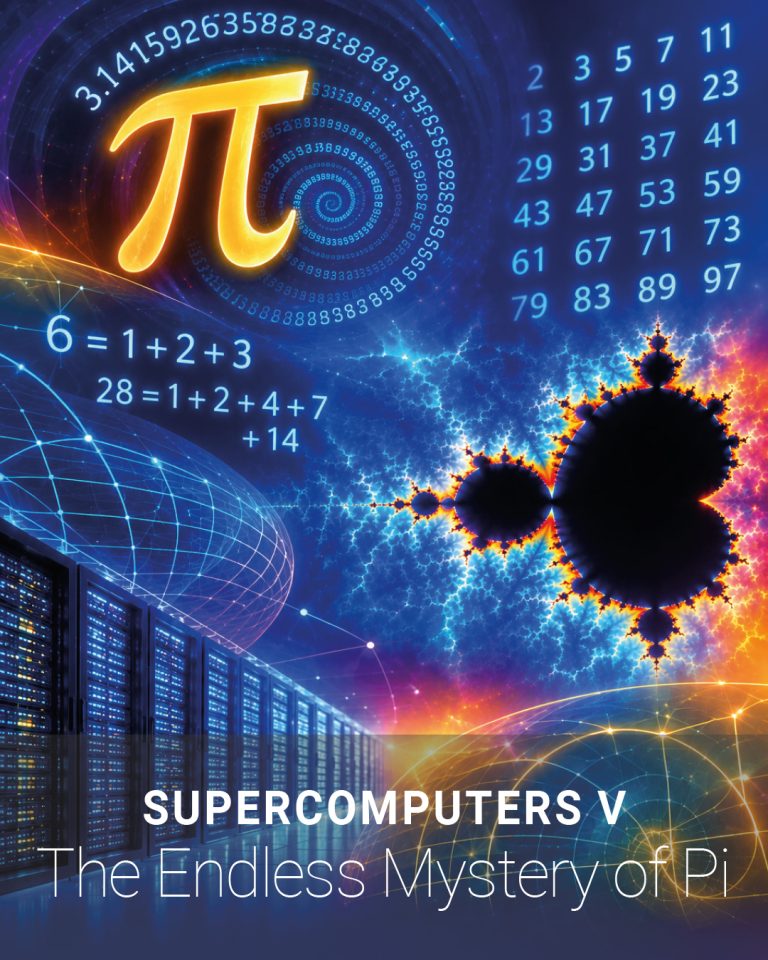
Pi (π) is one of mathematics’ most famous constants. It represents the ratio between a circle’s circumference and its diameter, approximately 3.14159. Its digits continue forever without repeating in a regular pattern, making it a fascinating subject for mathematicians and computer scientists.
Calculating trillions of digits of Pi is a remarkable demonstration of modern computing power, testing their processing power, improving mathematical algorithms and demonstrating advances in computing technology. Supercomputers use highly efficient algorithms, enormous amounts of memory and parallel processing to perform the calculations. Instead of working through every digit individually, specialised mathematical techniques allow computers to calculate vast numbers of digits much more quickly. Although these extra digits have little practical use in everyday engineering, they help researchers test hardware, software and numerical algorithms.
Searching for Prime and Perfect Numbers
Supercomputers also help mathematicians investigate prime numbers, which are whole numbers greater than one that can only be divided exactly by themselves and one. Prime numbers become increasingly difficult to discover as they grow larger. Distributed computing projects and powerful processors can test enormous candidates, helping researchers identify record-breaking primes and explore patterns in number theory.
Perfect numbers are another mathematical curiosity. A perfect number equals the sum of its positive divisors, excluding itself. For example, 6 is perfect because 1 + 2 + 3 = 6. Computers can search for larger examples and investigate their relationship with prime numbers, although finding new examples becomes increasingly challenging.
Exploring the Mandelbrot Set
The Mandelbrot set is a famous fractal pattern created by repeatedly applying a simple mathematical equation to complex numbers. Its intricate boundary contains extraordinary detail, revealing smaller patterns within larger ones.
Supercomputers can calculate millions or billions of points to generate highly detailed images of the set. They can also investigate its mathematical properties, exploring how its patterns behave at increasingly magnified scales.
Computing the Frontiers of Mathematics
From calculating Pi to searching for enormous primes and exploring fractals, supercomputers give mathematicians tools to investigate problems that would once have been impractical. They do not replace mathematical insight, but they can test conjectures, reveal patterns and generate evidence that helps researchers develop new ideas.
