





Improving Software for Society
News | Blog Post : CYBER LITERACY IN SCHOOLS
CYBER LITERACY IN SCHOOLS
28.07.2026
Cyber Literacy in Primary & Secondary Schools
Cyber literacy in UK schools focuses on online safety, critical thinking, and digital security, supported by guidance from organisations such as the UK Safer Internet Centre and UK government policies. While online safety is now a core part of the curriculum, many teachers say they would benefit from additional training and resources to help students navigate today’s increasingly complex digital and cybersecurity challenges. There is a gov.uk collection of online resources with a Media Literacy Action Plan (2026-2029) which explains what the government is doing to improve media literacy and the first steps being taking to help people feel safer, more confident and better informed online: www.gov.uk/online-safety-and-media-literacy.
This ties in with the UK government’s plan to introduce new legislation preventing children under the age of 16 from using major social media platforms, including TikTok, Instagram, Snapchat, Facebook, X, and YouTube. The proposed measures are expected to come into force in Spring 2027, with regulations scheduled to be presented to Parliament before the end of 2026. The proposals are intended to strengthen online safety for young people while allowing access to digital services considered essential for education, communication, and everyday life.
Learning Cybersecurity Through Everyday Maths
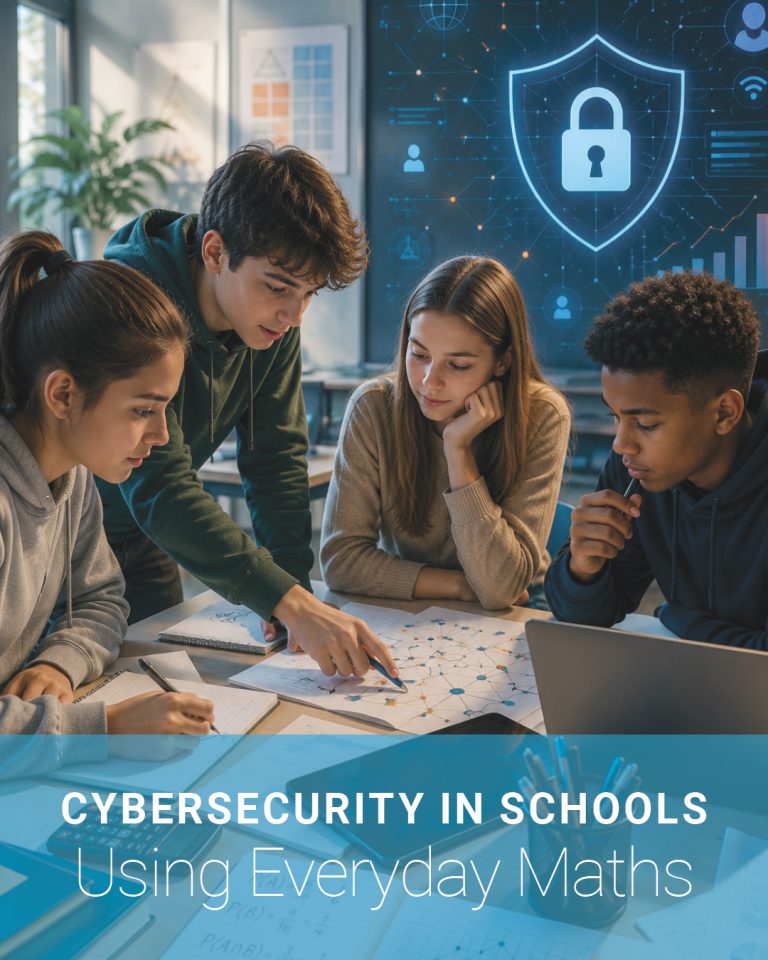
Cybersecurity is becoming an essential life skill, and schools are finding new ways to introduce it to younger learners. Using Mathematics combines simple mathematical concepts with online safety, helping students understand how digital threats work while reinforcing classroom learning. By linking maths to real-world cyber challenges, children develop practical skills that can protect them throughout their lives.
Making Cyber Concepts Easy to Understand
Age-appropriate lessons use familiar topics such as patterns, probability, logical reasoning, and basic data analysis to explain cybersecurity. Students can identify suspicious email patterns, estimate the likelihood of online scams, recognise strong password characteristics, and analyse simple datasets to spot unusual behaviour. These activities transform abstract cyber concepts into engaging, hands-on learning experiences that are easy to understand.
Strengthening Maths and Digital Skills Together
Integrating cybersecurity into mathematics lessons offers benefits beyond online safety. Students improve their problem-solving abilities, critical thinking, and logical reasoning while gaining confidence in using technology responsibly. Teachers can demonstrate how mathematical thinking helps identify risks, evaluate information, and make informed decisions in digital environments.
Preparing the Next Generation
As young people spend more time online for learning, communication, and entertainment, cyber awareness is becoming just as important as reading and numeracy. Introducing cybersecurity through mathematics provides a natural and accessible way to develop these skills from an early age. By combining core maths education with digital literacy, schools can help students become confident, informed, and responsible digital citizens who are better equipped to navigate an increasingly connected world safely and securely.
