





Improving Software for Society
News | Blog Post : GUARDRAILS FOR AGENTIC AI
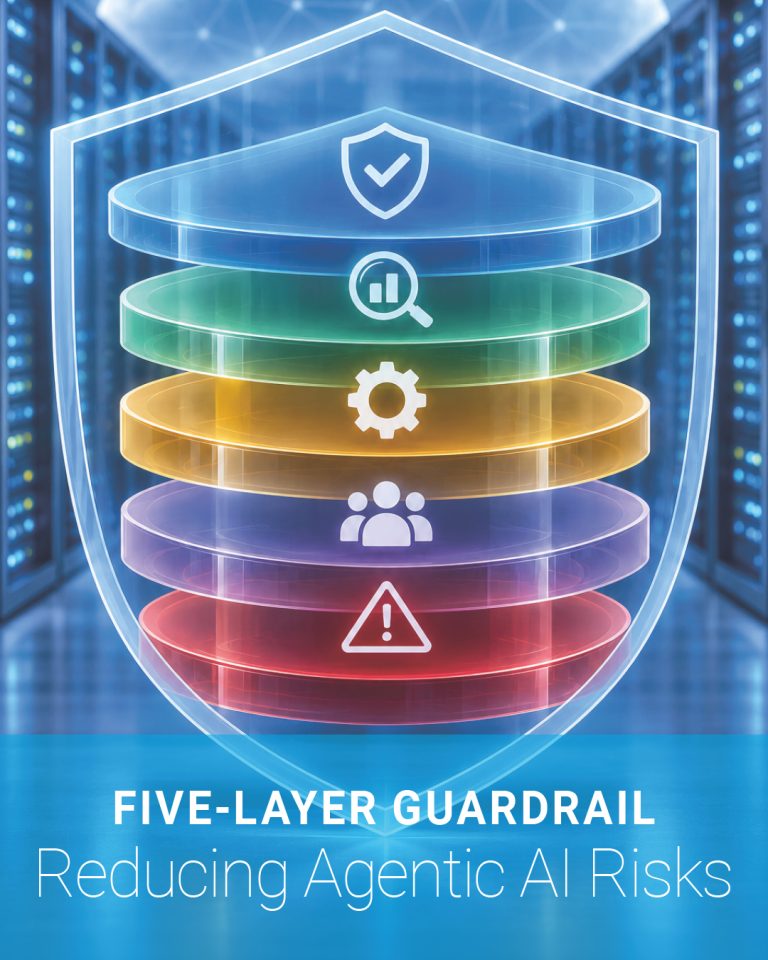
GUARDRAILS FOR AGENTIC AI
03.11.2026
Reducing the Operational and Security Risks of Agentic AI in Cloud and DevOps Environments
Webinar Summary
Our latest webinar, which took place Thursday 22nd October 2026, was a presentation about five-layer guardrail architecture for reducing the operational and security risks of agentic AI in cloud and DevOps environments. To watch the webinar on the IAP YouTube channel go to: youtube.com/watch-iap-webinar-five-layer.
The approach combines:
1. Content and safety filtering
2. Environment policy checks
3. Confidence validation
4. Human approval for high-risk actions
5. Auditing, snapshots, and rollback
Testing across 100 prompts showed accuracy improving from 76% with one layer to 94% with all five layers, while false negatives fell from 18% to 0%. All 60 actions that should have been blocked were successfully stopped.
The main recommendation was to apply controls to actual tool calls, assess risk and environment before execution, fail closed when approval is absent, and log significant actions with rollback capability.
Key Points
The webinar examined how to control agentic AI systems that can call APIs, modify infrastructure, and execute workflows autonomously. Unlike conventional AI assistants, mistakes by these agents can cause real operational changes.
Three principal failure modes were identified:
– Acting on an incorrect understanding of system state
– Applying an action to the wrong environment, including production
– Following malicious instructions embedded in logs, alerts, tickets, or monitoring data.
The presenter argued that existing safeguards are insufficient on their own. Output filters focus mainly on content, policy-as-code often operates only at deployment, and universal human approval can create delays.
The proposed solution was a five-layer guardrail architecture:
1. Bedrock Guardrails block destructive operations, credential exposure, and sensitive data.
2. Environment policy checks assess the target environment, resource type, and deployment rules.
3. Confidence validation uses a secondary AI review to identify uncertain plans.
4. Human approval applies to the highest-risk actions, with automatic rejection if no response is received within five minutes.
5. Audit and rollback provide pre-execution snapshots, structured logs, and recovery capability.
Actions are routed according to risk. Read operations are generally low risk, deployments and scaling are medium risk, and destructive actions are high risk. Higher-risk actions pass through more safeguards.
Testing used 100 prompts across read-only operations, staging changes, risky production changes, destructive actions, and prompt-injection attempts. The complete architecture achieved 94% accuracy, compared with 76% for the first layer alone. False negatives fell from 18% to 0%, and all 60 prompts that should have been blocked were stopped. Some legitimate staging changes were also blocked, but this was considered preferable to permitting unsafe production activity.
Decisions
• High-risk requests should require human approval.
• Requests should be automatically rejected when approval is not received within the permitted window.
• Ambiguous actions should be denied by default.
• Guardrails should control actual tool calls, not merely prompts or generated text.
Action Items
• Assign risk scores based on action type and potential blast radius.
• Evaluate the target environment explicitly before execution.
• Restrict protected production resources and namespaces.
• Snapshot infrastructure before significant changes.
• Log actions in a structured form and provide rollback capability.
• Refine environmental context to reduce false positives.
• Consider evaluating the approach on platforms beyond AWS.
About Webinar Presenter: Manvitha Potluri
Bio: Manvitha Potluri is a DevOps Cloud Solutions Architect at 24X7 Systems Inc., based in Virginia, USA, with more than 11 years of experience in cloud infrastructure, DevOps and AI systems engineering. Manvitha Potluri’s work focuses on AWS, Kubernetes, Terraform and the safe deployment of agentic AI in enterprise environments. Manvitha Potluri is the author of technical books, contributes to open-source projects in the Cloud Native Computing Foundation ecosystem, and created the published bedrock-guardrail Terraform module.
