





Improving Software for Society
News | Blog Post : HOW CLIMATE MODELS PREDICT CHANGE
HOW CLIMATE MODELS PREDICT CHANGE
27.10.2026
Investigating the AMOC Using Sophisticated Computer Models
What Is the AMOC?
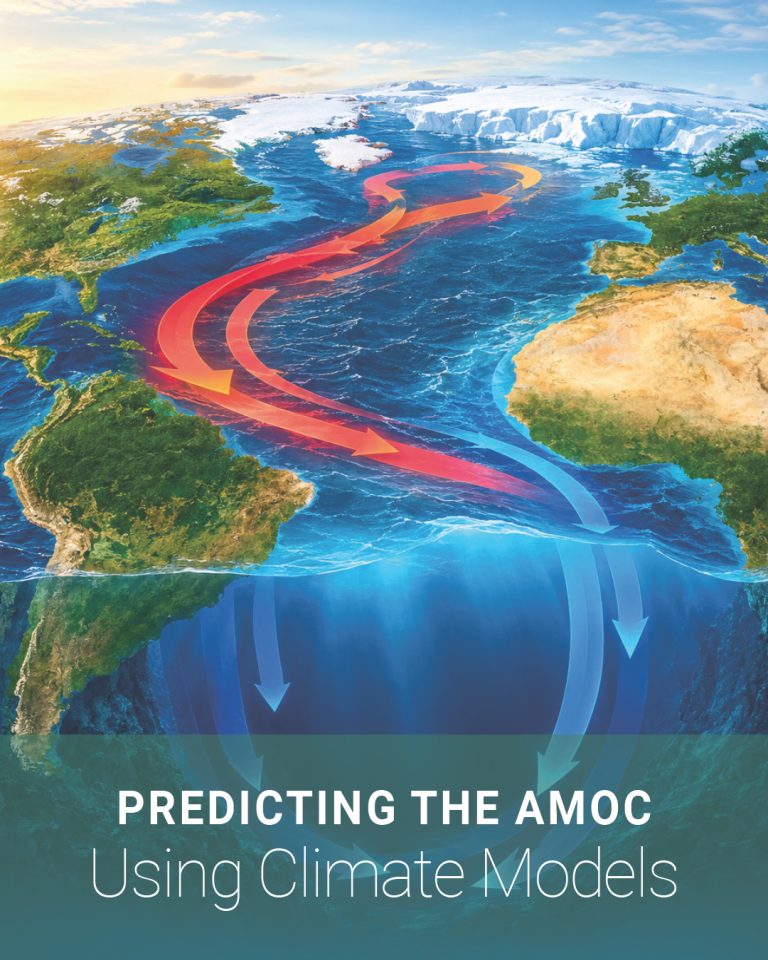
The Atlantic Meridional Overturning Circulation (AMOC) is one of the Earth’s most important ocean current systems. Often described as a giant underwater conveyor belt, it transports warm, salty surface water from the tropics towards the North Atlantic, while colder, denser water flows southwards at greater depths. This circulation helps regulate global temperatures and contributes to the relatively mild climate experienced in the UK and north-western Europe. However, climate change is raising concerns that the AMOC could weaken significantly, potentially altering weather patterns, rainfall and sea levels around the world.
How Climate Models Predict Change
Scientists use sophisticated computer models to investigate how the AMOC might respond to rising global temperatures. These models combine information about ocean currents, atmospheric conditions, salinity, water temperature, rainfall and melting ice to simulate the behaviour of the climate system.
Researchers run simulations under different greenhouse gas emission scenarios, allowing them to compare possible futures. Some models predict substantial weakening of the AMOC during this century, while others project smaller changes. Differences arise partly because the models represent complex ocean processes in different ways.
Could the AMOC Collapse?
One of the biggest questions facing climate scientists is whether the AMOC could reach a tipping point beyond which its circulation rapidly weakens or collapses.
As the planet warms, melting ice and increased rainfall can introduce freshwater into the North Atlantic. This reduces the water’s salinity and density, potentially making it less likely to sink and weakening the circulation.
A complete collapse could have profound consequences, including substantial changes to European temperatures, shifts in tropical rainfall belts and rising sea levels along parts of the North American coast.
However, scientists distinguish between a weakening circulation and a complete shutdown. The UK Met Office considers weakening during this century likely, while a total collapse is considered unlikely. Nevertheless, significant uncertainties remain, and researchers continue to investigate the risks.
Simulating a Complex Ocean
The AMOC cannot be understood by observing individual ocean currents alone. Its behaviour emerges from interactions between the atmosphere, oceans, ice sheets and the global carbon cycle. Rising temperatures cause Greenland’s ice to melt, introducing freshwater into the North Atlantic.
This reduces seawater salinity and density, potentially inhibiting the sinking process that helps drive the circulation.
To investigate these interactions, scientists use sophisticated computer models of the Earth’s climate system. These divide the atmosphere and oceans into three-dimensional grids, calculating how temperature, salinity, pressure, winds and currents evolve over time. Mathematical equations describe the underlying physical processes, while numerical methods enable computers to approximate their behaviour.
The most advanced models require enormous computing power, often using supercomputers with thousands of processors working in parallel. They can simulate decades or centuries of climate evolution, helping researchers explore how different greenhouse gas emissions scenarios might affect the AMOC.
What Does This Mean for the UK?
For the UK, changes to the AMOC could influence regional temperatures, rainfall and extreme weather patterns. A weaker circulation would transport less heat towards the North Atlantic, partly offsetting the warming caused by greenhouse gases in some regions. However, this would not necessarily mean that Britain would experience an overall colder climate. The wider effects of global warming would remain important, and the precise consequences of AMOC weakening are still being investigated.
Looking Ahead & Further Reading
Climate modelling provides a vital tool for assessing future risks, informing government policy and helping communities prepare for a changing climate.
As computing power increases, higher-resolution simulations, improved physical representations and better integration of observations should strengthen climate projections. Researchers can investigate not only whether the AMOC weakens, but also how any change might affect regional climates, ecosystems and societies.
Computing cannot eliminate uncertainty or predict the future with absolute precision. Its real value lies in turning physical theory and enormous quantities of data into testable scenarios, helping scientists assess risks and policymakers make better-informed decisions. Understanding the future of the AMOC is ultimately a computational challenge as well as a climate science challenge.
Improving climate models is essential for understanding how the AMOC might behave under different levels of global warming. Scientists are working to improve the resolution of ocean simulations, incorporate more accurate measurements and investigate the interactions between ocean circulation and the atmosphere. New research published in Nature Climate Change in August 2026 explored how quickly greenhouse gas concentrations rise and how this affects AMOC stability. The study suggests that the rate of climate change itself may influence the risk of crossing a tipping point, reinforcing the importance of limiting emissions.
Nature Climate Change: Failure to track a stable AMOC state under rapid climate change (2026): www.nature.com/articles/amoc
UK Met Office – Understanding the AMOC and its effects on climate: weather.metoffice.gov.uk/learn-about/weather/oceans/amoc
US National Oceanic and Atmospheric Administration (NOAA) – What is the Atlantic Meridional Overturning Circulation: oceanservice.noaa.gov/facts/amoc
UK House of Commons Library: Running AMOC: Is the Atlantic Meridional Overturning Circulation weakening: commonslibrary.parliament.uk/research-briefings
